


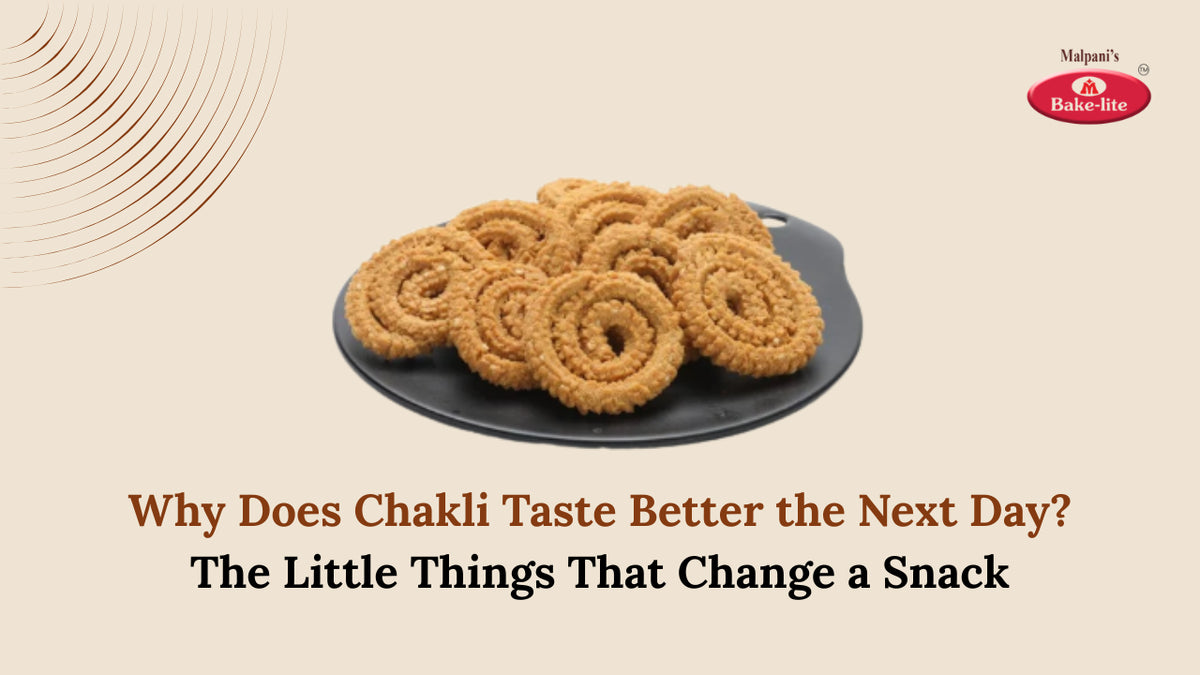
At 11 pm, the night after a faral day, someone opens the steel dabba and says the chakli is better today than it was yesterday. It was fried in a rush, somewhere between the karanjis and the chivda. Nobody argues. Hands go in for one more.
Quick take: Many people say yes. The likely reasons are full cooling, how the snack is stored, and a bit of habit. None of it has been proven in a lab, so here is a simple way to check at home, with one pack and two evenings.
Does chakli really taste better the next day?
It is a widely held kitchen belief, and I couldn't find any lab claim behind it. So treat it as a fair guess, not a fact. That is still worth testing. Split the idea into three parts: texture, flavour and mood.
Texture has some support. The recipe I checked says a chakli keeps firming up as it cools, and that storage matters. Flavour is mostly what cooks say, not what anyone has measured. Mood is the hardest to pin down. Day-two chakli is often eaten slowly, at the kitchen table, with the rush over, and that alone may make a snack taste better.
Chakli texture: what happens as it cools
Chakli keeps firming up as it cools. Pulled straight from the kadhai, it bites softer than you expect. Give it time and it sets. So before you judge a batch, wait until it no longer feels warm.
Part of the next-day story may simply be a chakli that finally finished cooling. If a batch goes into the tin while still warm, the steam has nowhere to go, and the chakli can turn soft.
A crispy chakli starts even earlier, at the frying stage. The same recipe calls for hot fat mixed into the dough and a medium flame under the kadhai. Too hot, and the outside browns while the inside stays soft. Too low, and the chakli turns hard.
One more small thing from that recipe: keep the dough covered while you press the spirals, so it doesn't dry out.
Spice, fat and the second-day flavour
Hot fat goes into the dough, and the spices go in with it. Ajwain, cumin, sesame, a little red chilli. Ask anyone who fries chakli at home and the second-day idea comes with a reason: the spices settle in overnight.
Cooks say the flavour spreads through the snack after a rest and blends better. I haven't seen anyone show it, so it stays kitchen wisdom for now.
For the factory side, the production team at Malpani's Bakelite, a Pune bakery and namkeen maker since 1999, says this about their own chakli:
“Ours is a traditional bhajani recipe, without artificial colours/flavours prepared under automated quality controls and hygiene at its core. The excess oil is extracted more than once to ensure the crisp minus the oiliness"
What counts as traditional chakli
Traditional chakli is a spiral of dough, deep-fried till crisp. The dough is typically rice-based or multi-grain. Maharashtrian versions often use bhajani, a roasted multi-grain flour. Spice mixes change from home to home, but the spiral and the deep-frying stay the same.
Chakli belongs to the Indian namkeen family, along with chivda, sev and farsan. Most of them are meant to crunch, so the tin matters too.
Small things that keep chakli crispy
Most of it comes down to air and moisture. A few habits help:
-
Cool the chakli fully before it goes into the tin, even if the family is waiting.
-
Use an airtight container, kept at room temperature.
-
Always take it out with a dry spoon.
-
Keep the tin away from kitchen steam, so not beside the stove.
-
For a shop-bought pack, check the best-before date.
If a chakli goes soft
A common home fix is a minute in a dry pan on low heat, then a full cool-down before eating. It is a cook's trick, not a tested method, so try it on a few pieces first.
If there is no time to fry this faral season, Malpani's Chakli comes in a 200 g pack and is marked Best Seller on the site.
Try the two-day test at home
-
Open a fresh pack and eat a few pieces with evening chai.
-
Seal the rest in an airtight tin.
-
On day one, at the same hour, eat the same amount.
Before you close the tin
The answer may simply be in the tin. Fill it only when the chakli has cooled, close it properly, and open it tomorrow at the same hour. Then decide for yourself. If frying is not happening this year, a pack of Malpani's Chakli is available on malpanifoods.com.
FAQs
Q. Why does chakli go soft?
A. Chakli goes soft when it picks up moisture from the air, a wet spoon or kitchen steam. Store it airtight at room temperature, once it has fully cooled.
Q. How long does chakli stay crispy?
A. Check the best-before on the pack, since that is the maker's guide for packed chakli. For a home batch, a full cool-down and an airtight tin give it the best chance.
Q. Is chakli a namkeen?
A. Yes, chakli is a savoury, deep-fried snack from the namkeen family.
Q. What do you eat chakli with?
A. Evening chai is the usual pairing, and in faral season it shares the plate with chivda and laddoo.


